Minor Hockey Financial Management Protects Volunteers
Several years ago, a minor hockey association experienced a serious breakdown in its team financial recordkeeping.
Expenses had been tracked inconsistently. Supporting receipts were incomplete. The spreadsheet being used did not provide a reliable account of how team funds had been collected or spent.
The gaps were serious enough to lead to a formal investigation.
Association officers who had not maintained the day-to-day records were still required to answer questions about the team's finances. People who had volunteered their time in good faith suddenly found themselves under significant personal scrutiny.
The lesson is important for every youth sports organization: minor hockey financial management is not simply about keeping an accurate spreadsheet. It is about protecting parents, team managers, treasurers, board members, and the reputation of the association itself.
Poor Records Can Put Good Volunteers at Risk
Most minor hockey treasurers and team managers are not professional bookkeepers. They are parents and community members who have volunteered to help.
Yet they may be responsible for tens of thousands of dollars over the course of a season. Team fees, tournaments, additional ice, equipment, fundraising, sponsorships, travel, development programs, and refunds can create hundreds of individual transactions.
The volunteer is often expected to manage all of this using a spreadsheet, a bank account, a folder of receipts, email messages, and text conversations.
That process may appear to work when everything is going smoothly. Its weaknesses become apparent when:
- a receipt cannot be located;
- an expense was approved verbally but never documented;
- the spreadsheet does not match the bank balance;
- a budget category is interpreted differently by different teams;
- a parent questions how team fees were used;
- the team manager leaves before the records are complete;
- or the association needs to review several seasons of activity.
Poor records do not automatically mean that money was misused. However, when the records are incomplete, it can become very difficult for an honest volunteer to demonstrate that everything was handled properly.
Financial controls should not be viewed as a sign that an association distrusts its volunteers. Good controls protect good volunteers.
What Strong Minor Hockey Financial Management Looks Like
Many minor hockey associations already require teams to prepare budgets, provide financial updates to parents, retain supporting documentation, reconcile bank accounts, and obtain more than one approval for financial activity.
For example, the Nepean Minor Hockey Association's competitive team budget policy calls for regular budget reporting, supporting documentation, monthly bank reconciliation, parent approvals, and two signatures for team transactions.
The Kitchener Minor Hockey Association's financial policy similarly requires team budgets, financial statements, monthly reporting to parents, and two co-signers for withdrawals.
The challenge is not usually the absence of policy. The challenge is giving volunteers a practical way to follow the policy consistently throughout the season.
A strong financial management process should include five basic elements.
One Consistent Team Budget
Every team should begin with an approved budget that clearly shows expected revenue and expenses.
Associations can make reporting easier by establishing standard budget categories for every team. Ice, tournaments, equipment, player development, fundraising, sponsorships, and team fees should be classified consistently across the organization.
Standardized categories make budgets easier for parents to understand and allow association leaders to compare financial activity across teams.
Supporting Documentation for Every Expense
A number in a spreadsheet does not explain the transaction by itself.
Each expense should include the vendor, date, amount, budget category, description, and supporting receipt or invoice. These records should remain connected so that a reviewer does not have to search through email accounts, paper folders, and personal devices.
If an association requires financial records to be retained for several years, cloud-based storage can help keep those records accessible after the original team volunteers have moved on.
Documented Approvals
Many team bank accounts require two people to approve a payment. That is an important banking safeguard.
The team's financial records should also show who reviewed the underlying expense and when it was approved. These are related but distinct controls.
The bank controls the movement of money. The team's financial management system documents the purpose of the expense, the supporting receipt, its budget category, and the people who reviewed it.
Regular Reporting to Parents and the Association
Financial transparency should not be limited to a spreadsheet distributed at the end of the season.
Parents should receive regular budget-to-actual updates showing:
- how much money the team collected;
- how much it spent;
- what remains in each budget category;
- whether spending is ahead of or behind budget;
- and whether any significant changes are expected.
Association leaders should also be able to confirm that teams are submitting the required reports without repeatedly chasing managers for updated spreadsheets.
A Clear Year-End Record
At the end of the season, the team should be able to produce a complete financial package that includes:
- the approved budget;
- actual revenue and expenses;
- bank transaction records;
- receipts and invoices;
- documented approvals;
- fundraising and sponsorship activity;
- outstanding amounts;
- and the final treatment of any surplus or deficit.
That package should remain available for the period required by the association's policies.
Why Spreadsheets Alone Create a Visibility Gap
Spreadsheets are useful tools, but they were not designed to provide complete financial oversight across a minor hockey association.
A spreadsheet does not automatically connect to the team's bank activity. It does not ensure that every expense has a receipt. It may not preserve a reliable approval history. It can be copied, overwritten, emailed to the wrong person, or stored on a volunteer's personal computer.
The problem becomes larger at the association level.
If every team uses a different spreadsheet, different budget categories, and a different process for storing receipts, the board may technically have financial policies without having a consistent view of whether those policies are being followed.
Transparency should not depend on one volunteer remembering to update and distribute the correct version of a file.
How HuddleBooks Supports Financial Transparency
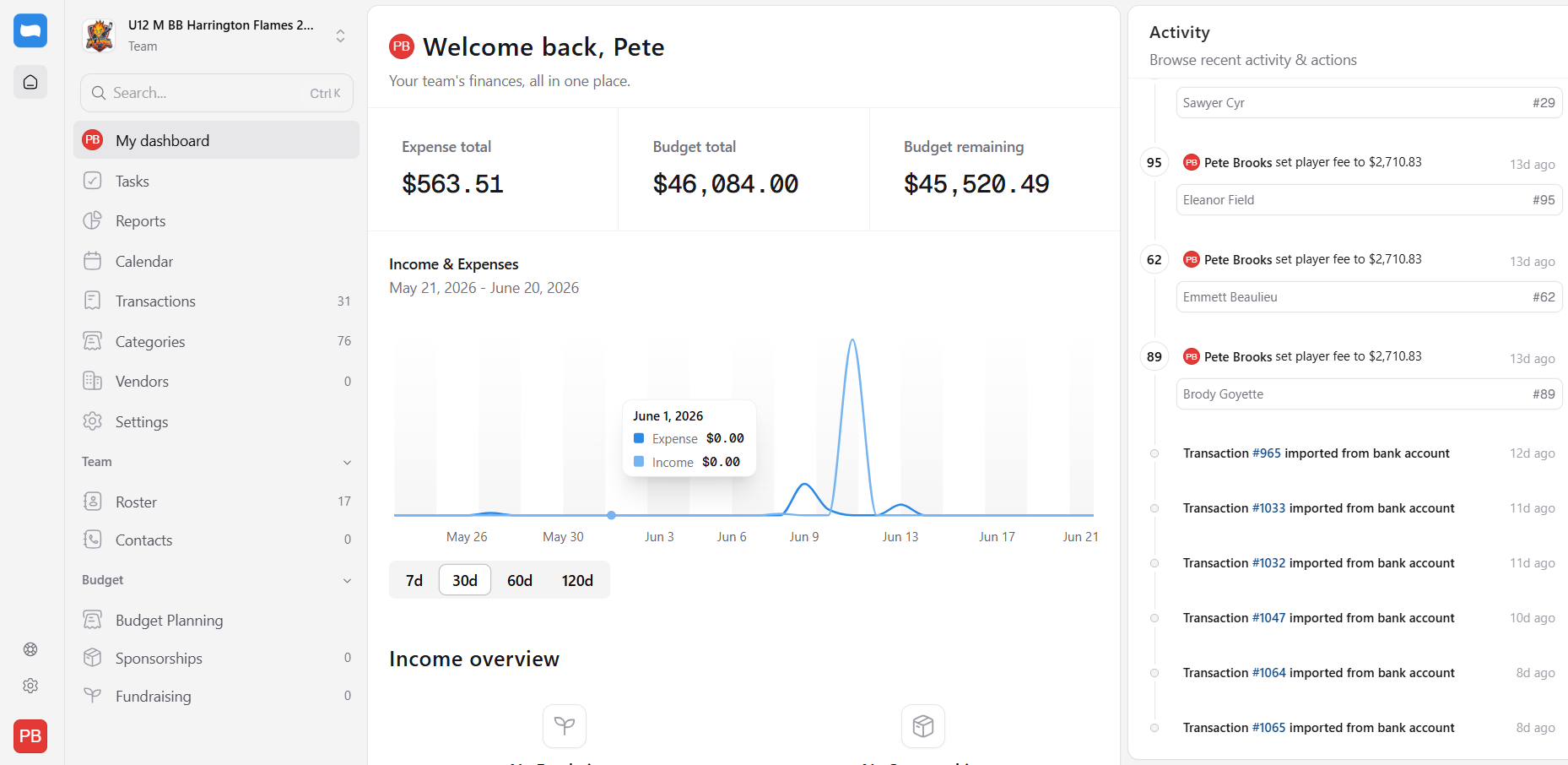
HuddleBooks gives minor hockey teams a shared, consistent way to manage budget visibility, transaction support, approvals, and season-long financial updates.
It brings the team's financial records together in one place:
- Team bank transactions are synchronized daily through a read-only connection.
- Expenses can be categorized against the approved budget.
- Receipts and supporting files remain attached to the relevant transaction.
- Expense approvals are documented within the team's records.
- Parents can receive current visibility into how team funds are being used.
- Association leaders can oversee multiple teams through a consistent process.
- Standard budget categories can be established across the association.
- Records can be stored securely in Canada and exported when required.
HuddleBooks does not replace the team's bank account, the bank's payment approvals, or the association's financial policies. It helps teams maintain the records needed to demonstrate that those policies are being followed.
Better Systems Help Establish Trust
Financial transparency is not about assuming the worst of volunteers.
It is about recognizing that no volunteer should be left alone to manage a large team budget with a spreadsheet, a folder of receipts, and no reliable way to show their work.
When budgets, transactions, receipts, approvals, and reports are maintained consistently, parents gain confidence in how their money is being used. Treasurers spend less time answering questions and reconstructing records. Boards gain better oversight. Volunteers are protected by documentation instead of being forced to rely on memory.
The goal is not to catch bad actors. It is to protect good people from impossible situations.
Book a Conversation About HuddleBooks
If your minor hockey association wants stronger financial visibility without creating more administrative work for its volunteers, see how a shared financial record could work across your teams — using the policies and approval requirements your association already has in place.